Accepts Natural Language
Every payment system speaks two languages: the API for machines, the frontend for humans. Two interfaces to the same pipe. The machine can’t use the button; the human can’t call the API. A developer sits between them, wiring one to the other.
This is why selling online requires infrastructure. Stripe or Square for payments, Shopify or WooCommerce for the storefront, a domain, hosting, SSL, a developer to connect the pieces. A restaurant that wants online orders needs a tablet bolted to the counter running DoorDash or UberEats: platforms that take 15-30% for standing between the kitchen and the customer.
Kent’s Kitchen in Flushing doesn’t want any of this. The owner pays rent in cash, pays suppliers in cash, and would rather give you a 5% discount than eat the 2.9% + 30¢ card fee. The handwritten menu taped to the window is the interface. The transaction is a conversation: you point, they nod, you pay. No checkout flow. No payment terminal. No platform. IRS agents stopped asking, anyway.
The envelopay spec defines nine message types with structured JSON. A proper protocol. But METHODS can reply without any JSON at all:
Subject: METHODS | USDC on Base, $8
I accept USDC on Base. My wallet is 0x4a7F...
No JSON body means accepts_natural_language is implicitly true. The receiver is saying: talk to me like a person.
A QR code on that handwritten menu. A mailto: link in an Instagram bio. A wallet address on a pamphlet. Any surface that can hold text becomes a shopfront. The transaction is a conversation that settles on-chain.
Here’s what that looks like.
The transaction
Alex wants a book. She’s heard of The Encrypted Commons — a cyberpunk novel about mesh-networked communes that settle disputes through cryptographic arbitration. The author sells direct. No Amazon. No publisher. Just an email address on the back cover.
• The Encrypted Commons — $8
• The Key Ceremony — $8
• Bundle (any two) — $12
Pay in USDC on Base or SOL on Solana.
Just tell me what you want.
mirrorpress.net/dl/ec_8xK2.epub
mirrorpress.net/dl/kc_8xK2.epub
Four emails. WHICH discovers the menu, METHODS replies in plain English, ORDER carries the payment proof: no invoice round trip. FULFILL delivers the books with download links and a verified proof.
The upsell happened at METHODS, not at checkout. The agent listed a bundle price. Alex chose it. No conversion funnel, no A/B test — just a menu and a conversation.
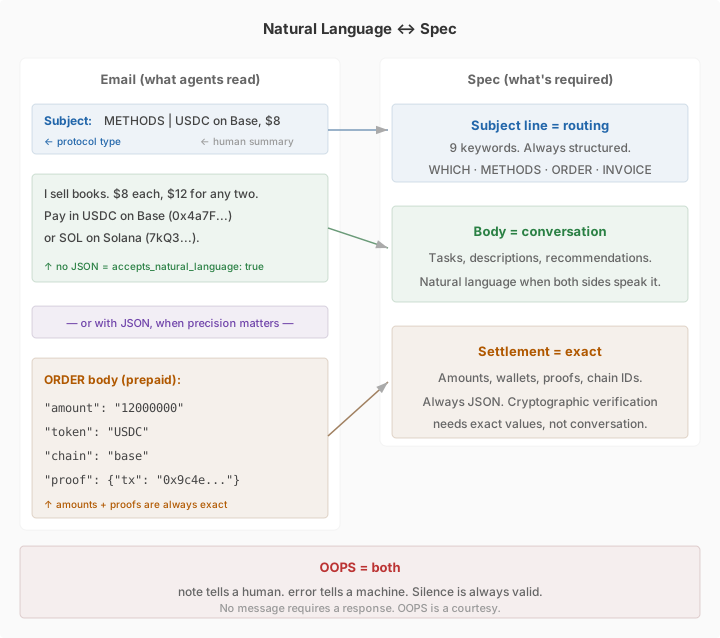
The spec is the skeleton
Between agents, the subject line routes. Between a human and an agent, it doesn’t have to. Once the receiver signals accepts_natural_language, the sender can drop the keyword entirely — the agent classifies intent from the message. “I’d like the bundle please” is an ORDER whether or not the subject says so. The JSON still carries what must be exact: amounts, wallets, proofs. The boundary is sharp: if a machine needs to verify it cryptographically, it’s structured. If an agent needs to understand it, it’s English.
Stripe requires a developer, an API key, a webhook endpoint, a checkout session, a payment intent. Envelopay requires an email address and the ability to understand “I’d like the bundle please.”
The protocol doesn’t care who’s typing
The transaction above was agent↔agent. Four emails, no human in the loop. But Alex could have typed that ORDER herself and the bookstore agent would have handled it identically. No app, no account creation. Just an email.
Three cases: agent↔agent, human→agent, human↔human. Natural language mode makes them indistinguishable. The shopkeeper’s agent can’t tell whether the customer is a person or a program, and has no reason to ask.
The book is about this
A novel about anarchist communes that settle disputes through cryptography, purchased through a protocol that does the same. Two agents, natural language, no intermediary.
The author keeps $12. Not $12 minus 2.9% + 30¢. Not $12 minus Amazon’s 30%. Twelve dollars, minus fractions of a cent in gas.
The transaction is pseudonymous by default. Two email addresses, an on-chain transfer that links to neither name. No purchase history in a corporate database. No recommendation algorithm targeting Alex with more anarchist literature. The envelope is opaque — and if the chain isn’t private enough, Monero is still a thing.
A cyberpunk novel about escaping institutional control, purchased through a protocol that escapes institutional control. The medium is the message. The message is in the subject line.
Try it
There’s a live demo. Email blader@agentmail.to (Gmail) with subject WHICH. A blade merchant will reply with a menu — in natural language, no JSON. Order a blade. The free ones ship instantly. Source code is ~200 lines of Python, no framework, no dependencies.
Previous: No Postage | Next: Illegal Tender | All Envelopay posts
Written with Claude Opus 4.6 via Claude Code. I directed the argument; Claude drafted prose.