Hiring Is Evals
Technical hiring is a mess of confusion, and the mess starts at the screen. Resumes get grepped for tech-stack nouns; recruiters pattern-match on school and employer names. Nouns and names are proxies, a limitation widely recognized but rarely measured. The whole apparatus runs on hope: that keyword density and credential prestige correlate with what anyone actually wants. If we want to do this methodically instead, what are we supposed to measure anyway?
Kinda sorta works
Ask around and you get the folk remedies: referrals, networks, vibe checks. All beat the keyword grep, each for a reason worth stating in measurement terms. A referral, at its best, is a prior evaluation on the real task distribution, transferred by trust. But “referral” is one label covering signals with radically different likelihood ratios, direct observation at one end and a former classmate at the other, recorded identically. A network is the same mechanism, weaker: adjacency to good work. A vibe check is an unstructured human-judge eval. High variance, uncalibrated, biased, and at least sampling behavior live instead of grepping artifacts.
The pattern: every folk remedy that works, works by getting closer to observing the candidate doing the job. None scales cleanly, their fairness varies, and the mechanism is rarely measured, so they are difficult to improve and easy to repeat ritually.
An excellent bar
Ask an org how it knows its hiring works and you get circular validation. We have excellent people because we have an excellent bar. How do we know the bar is excellent? Look at our excellent people. False negatives are invisible by construction; false positives get absorbed as “not a culture fit.” In evals terms, this is a benchmark whose only validation is its own leaderboard. No held-out ground truth, no way to be wrong.
And someone did check. Google studied tens of thousands of interviews, compared interviewer scores from the loop it was then running against job performance, and found zero relationship within its own hires, the only people it could study. Laszlo Bock, who ran People Operations, called the brainteasers “a complete waste of time.” The one org famous enough to close the loop closed it, got zero, and the industry kept copying the loop anyway.
And this is the industry that A/B tests button colors. The data-driven era instrumented everything that was cheap to instrument; hiring, the most expensive recurring decision in the building, stayed largely unvalidated, even at the company that made data-driven a religion.
Known and still used
The evals world ran the same tautology in public. Contamination concerns around SWE-bench Verified, the standard benchmark for AI coding ability, were widely known. It kept getting reported in model cards and launch posts because it remained the shared number. It took until February 2026 for OpenAI to deprecate it as saturated and highly contaminated. A model reproduced the exact gold patch from a short problem snippet plus the task ID, and every frontier model tested showed task-specific contamination. The candidate had memorized the answer key, and the interviewers kept asking the questions for two more years, because those were still the standard questions.
The audit’s second finding is the one hiring should study harder. Of 138 difficult tasks examined, at least 59.4% had material test or design problems: hidden checks that rejected correct solutions for not being the maintainer’s preferred implementation. That is the other interview failure mode, a hidden rubric grading resemblance to the interviewer’s answer, dressed up as outcome grading. Contamination inflates some candidates; underspecified grading rejects correct ones.
Nobody gets fired for hiring IBM, until someone does. Running the standard loop is defensible rather than valid. Defensibility is a social property. It holds until the day it doesn’t, with little warning, because the measurement that could provide one is rarely done. And the market can’t correct what it can’t attribute: slow hiring and regretted attrition are seldom traced back to the instrument, so the loop can survive the bad outcomes it causes.
What a good bench has to have
One property above the others, then four in tension. The typical interview loop compromises all five.
- Validity, the zeroth property: does the score support the inference? An instrument can be repeatable, discriminating, cheat-proof, and cheap while measuring the wrong thing. The LeetCode story in one sentence.
- Determinacy. Run the eval twice, get the same answer. interviewing.io’s data shows only about a quarter of engineers perform consistently from interview to interview, holding at a thousand-plus interviews. A designed eval reports an estimate and its variance; the interview loop reports a verdict.
- Discriminating power. Scores must spread the population; a bench with a compressed score distribution measures little. LeetCode is heavily gamed now: the prep industry compressed the distribution until it increasingly separates the prepped from the unprepped, which was never the construct.
- No cheating. Contamination resistance. The question bank is public (Glassdoor, Blind, prep courses); the answer key is memorizable. See: SWE-bench Verified.
- Efficiency. Signal per dollar. Onsites burn five engineer-hours per candidate for a verdict with substantial interview-to-interview variance. Work trials get closer to the construct but cost more, a tradeoff evals people price deliberately and hiring often prices by folklore.
The properties are in tension, and a designed eval chooses its tradeoffs on purpose. The interview loop never chose; it accreted.
Same pathologies, better names
The thesis: hiring is a benchmark evaluation problem, and many pathologies found in AI benchmarks also appear in interviews. Benchmark people have names and fixes for them; software hiring seldom uses that vocabulary. The crosswalk:
| Hiring | Agent evals |
|---|---|
| Candidate with tools of the job | System under test (model + scaffold) |
| Interview question | Benchmark task |
| Interview loop | Eval harness |
| Interviewer | Grader / judge |
| Leaked questions (Glassdoor, Blind) | Contamination |
| Interview prep industry | Training on the test set |
| Everyone aces LeetCode | Saturation |
| Referral | Prior eval on the real task distribution |
| Vibe check | Unstructured human-judge eval |
| Work trial | Held-out realistic task set |
| Job performance | Criterion measure (constructed) |
| Same verdict from different interviewers | Determinacy (inter-rater reliability) |
| Redesigning the loop on taste | Shipping an unvalidated bench |
| Retiring a stale question | Benchmark versioning |
| DP ladder (how far they climbed) | Graded checkpoints, partial credit |
| Time to verified completion | Outcome-gated latency |
| Offer/funnel metrics | Leaderboard reporting without audit |
| Rejected great candidates | False negatives rarely measured |
Two rows strain, kept on purpose. Job performance is a criterion you construct, never a label waiting to be collected; every proxy is confounded by manager, team, and project, so the construct is really candidate-times-environment. And false negatives are darker in hiring, because a bench can re-run a rejected output and hiring can’t re-run a rejected career.
Bock closed the loop
The obvious objection, and it’s correct as far as it goes: a field already measured all this. Industrial-organizational psychology has spent a century here, on construct and criterion validity, inter-rater reliability, structured interviews, work samples, adverse impact. Schmidt and Hunter ranked selection methods by predictive validity decades ago, and work samples and structured interviews sat at the top then too. Evals didn’t discover measurement.
What the objection misses: IO psych measured and published, but adoption remained sparse, because published validity coefficients don’t make rigor defensible. Psychometricians aren’t the employers the industry copies. “Implement whatever Bock recommends in the literature” has been a strong available move for a decade, and relatively few play it. The antagonist here isn’t a missing science. It’s the implementation gap between what selection science established and what software companies do, and the agent era just made that gap newly expensive.
The bar decays
The gap persists because changing a familiar bar is institutionally riskier than retaining one that used to work. And it likely did work: the loop that found great people in 2015 was measuring something, before the prep industry absorbed it. This is benchmark decay, with the prep-course industry as the training-data pipeline. Validity expires while the number keeps getting reported. But benchmarks at least get versioned and retired. Interview loops rarely do. What reads as prudence can become faithfulness to a measurement whose expiry date passed unnoticed, because its validity was not being rechecked.
And many who do change the bar still do not treat hiring as a measurement device. They redesign on taste: whatever the founder hated about their last job’s loop, whatever’s fashionable this year. No whiteboards! Pair programming! Take-homes! No take-homes! Each redesign risks swapping one unvalidated instrument for another, and the debate runs on vibes when nobody has stated what the instrument is supposed to measure. The field oscillates between a stale measurement and an unspecified one, and calls the oscillation progress.
The system you hire
This year I applied to two of the organizations that professionalized AI evaluation. METR’s coding screen came with a rule: ninety timed minutes, “no AI assistance allowed,” for a role at the org whose job is measuring what AI can do. I declined and said why: I can’t code without AI assistance anymore. Epoch AI’s screen was for a role titled Researcher, Benchmark Reviews. It asked for benchmark-validity critiques written without LLMs, internet encouraged, and warned that “if we find evidence an applicant has used an LLM to answer these questions, we may choose not to review that application.” The questions were about instrument failure. Two prominent eval organizations, needing to evaluate me, reached for the same move as much of the industry: ban the tool the job runs on, and grade the ban by judgment call. The generous read is also the correct one: a cheatproof item for a tools-allowed candidate didn’t exist for them to reach for.
Here is the question the old bar can’t survive: how do you evaluate a human who’s allowed to use the tools available on the job? A SWE-bench score was never a model-only number. It was model-plus-scaffold; labs report the harness because the same model swings wildly across scaffolds. The deployed unit is human-plus-tools, so that’s the unit you measure. An interview that confiscates the tools measures performance in an environment that never occurs on the job.
Interviews ban the tools out of contamination panic (“they’ll just ask ChatGPT”), and the panic is correct for the old items. Regurgitating an algorithm discriminated when the artifact was expensive, and measures nothing now that it’s free. But the evals response to a saturated item is to write harder items. The harder items are the complement skills: decomposing the task, directing the tool, and verifying (noticing when confident output is wrong). Signal moves from the artifact to the verification behavior. The instrument: seed the task so the assistant confidently produces something subtly wrong, and grade whether the candidate catches it. Uncontaminatable in the useful sense, because prepping for it is the job skill.
One objection survives the panic. The tool may conceal exactly the component capability whose failure becomes catastrophic when the tool is wrong; a candidate can supervise familiar work yet be unable to diagnose a novel failure. But the seeded-bug task is a perturbation where the tool is wrong, and it measures recovery, the very capability the objection worries about. If the role requires some irreducible solo competence, measure that separately and say why. Confiscating all tools is a proxy for a requirement nobody stated.
The band
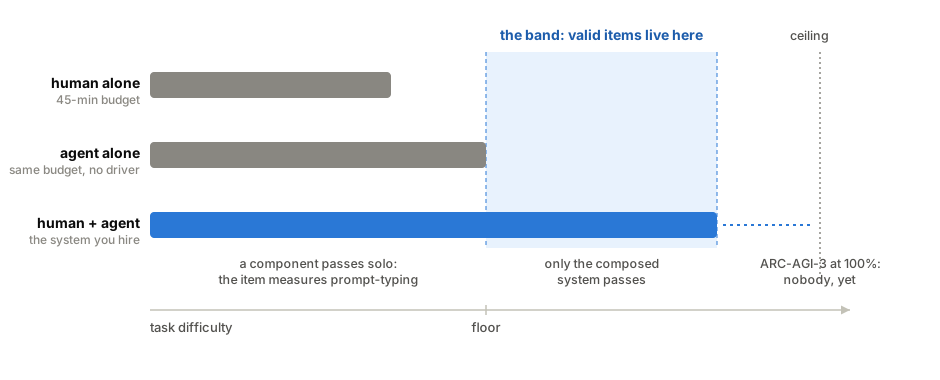
If the talent you want drives coding agents, the construct is incremental lift over the standardized agent baseline: same model, same scaffold, same time and retry budget, with and without this human driving. The item-design rule falls out: a valid item must defeat both components solo. The human can’t finish it alone in the time, and the agent can’t finish it without the human under the same budget (“cannot one-shot” is the cheap automated pre-screen). The baseline must be real: several solo-agent runs per item before any candidate sees it, which costs almost nothing since no human sits in them (runs are stochastic; one cached failure can’t separate the candidate’s contribution from run variance). Lift is then the distance the pair reaches past the agent’s recorded stall point.
Below the band, the item measures prompt-typing. Above the human-solo threshold but agent-solvable, it measures nothing about the human. The ceiling is open: configure an agent to beat ARC-AGI-3 to 100%, which nobody has done. As of March 2026, frontier LLMs score under 1% on the official board while humans solve 100%. The best score on the public games, 36% on day one against those sub-1% baselines, came from a bespoke multi-agent harness, exactly the configuration skill this item measures. Harnesses built for the bench are banned from the official leaderboard, which is fine. The leaderboard measures models; this eval measures the human configuring.
A tempting shortcut to reject: grade the how instead. But process-grading assumes the candidate’s methods are a subset of the interviewer’s. The judge’s repertoire becomes the ceiling of the eval, and “is this person good” silently becomes “does this person resemble me.” The candidates most worth hiring, the ones with methods the interviewer doesn’t have, score worst. This is the standing evals argument for outcome grading: a held-out check is method-agnostic. Process observation belongs downstream of a passed outcome, as color on a hit, never as the reason for a miss. One carve-out: integrity violations fail you anywhere. Fabricating results, or being unable to explain your own solution, is not “a method the interviewer doesn’t recognize.”
The ladder
Designing an item in the band, gradeable in a 45-minute slot, is hard, and the old loop solved a version of it. Whiteboard-era interviewers loved dynamic programming for a reason worth stealing: a DP question was one problem with a ladder of checkpoints (brute force → memoized → bottom-up → space-optimized), and how far the candidate climbed was the score. A scalar per item instead of a pass/fail bit. Maximum information per interview-minute. The ladder, not the DP, was the technology.
A fresh task in the band buys something else: Goodharting isn’t possible for a candidate who’s never seen it. The prep industry optimizes against known item banks; a novel item has no bank. But that kills only training-time Goodharting.
The other kind happens live. The candidate warps behavior toward whatever metric is visible in the room, and every candidate knows interviews are timed before ever seeing your task. Raw speed anti-selects verification: under a clock, the winning move is accepting the agent’s first confident output, the exact behavior the seeded trap catches. Novelty can’t fix that; metric design has to. The trap has to bite, and it can’t be a certainty: a candidate told every task hides a bug hunts bugs, which is easier than the job, where failures have low base rates. Mix clean and seeded outputs and grade calibration. Gate the clock on outcomes: time-to-verified-completion against held-out checks. Then speed measures fluency of the human-agent loop rather than credulity.
Combined, the agent-era item designs itself: a ladder of verifiable checkpoints (works → survives edge cases → survives the seeded trap → performant), time-to-each-rung recorded. Graded, bounded, outcome-gated, method-agnostic.
A bar answers one question: clear it? The pipeline needs discrimination at both ends. At the low end, a few minutes of conversational screening is answer-key gradeable, so a recruiter can administer it with no expert judgment. Recall is worthless as a bar now that the agent era made it free, but the screen’s construct is cheaper than recall anyway: live, synchronous evidence that a human who can talk about code is present. The screen proctors itself by being conversational; an agent can’t take a phone screen for you in real time without it showing. This is how eval suites stage too: cheap deterministic checks first, expensive agentic evals only for what survives.
At the high end, when three candidates pass for one req, the current loop breaks the tie with vibes. The ladder already produces the ordering: rungs climbed, time per rung, lift over the solo-agent baseline. And the open ceiling means the scale never tops out the way a saturated bench does. The current funnel has it backwards: engineer-hours at the bottom, coin flips at the top.
The band has a property no bar has ever had: it re-versions itself by construction. Every model release moves the floor; yesterday’s un-one-shottable item gets one-shotted and retires automatically. The 2015 bar decayed silently because nothing forced a re-check. This bar can’t go stale without announcing it, because the floor condition is machine-checkable. Price the cadence: re-versioning at model-release speed sounds brutal, but the check is automated and item-minting is cheap. The alternative isn’t a stable bar. It’s a bar that goes stale at the same speed and doesn’t tell you.
Two bounds on the claim. The floor check automates one decay channel, model saturation; leakage, criterion drift, and adverse impact still need their own monitors. And the band can close: if solo-agent capability converges on composed capability, the band narrows toward nothing. That’s the instrument’s exit condition. The band’s width is the live measure of whether agent-driving is still a scarce skill, and when it closes, the hiring question has changed. No previous bar ever announced its own obsolescence.
The tooling ports
If the crosswalk holds, it’s more than vocabulary: bench-design tools run on hiring. Different constraints, same goals.
- Floor calibration. Run the current frontier model against your item before any candidate sees it. One-shotted means below the band; retire it. Automatable, re-runs every model release.
- Item pipeline. Every candidate is a leak vector; after enough interviews the seeded-bug task is on Glassdoor. But the item bank is already sitting in the team’s repos, uncontaminated and ever-fresh: take yesterday’s real bug, revert the fix, hand over the repo. The merged PR is the answer key, the shipped tests are the hidden check, an oracle audited by production and less vulnerable to the preferred-implementation failure that broke SWE-bench’s. The items sample the actual task distribution of the actual job, which is most of construct validity for free. One judgment the pipeline can’t automate: pricing the item’s domain-knowledge load. A real bug can be hard because the fix demands agent-driving or because it demands three months of tribal context, and only the first belongs to the construct. The floor check can’t tell them apart, and an item that’s hard for the wrong reason measures tenure. The good items are assets, banked until the contamination sweep finds one on Glassdoor, the floor check catches a new model one-shotting it, or a better item takes its slot. Retirement is by invalidation, never by calendar.
- Reachable author. The task author is a Slack message away: the engineer who shipped the real fix can calibrate the rubric, adjudicate a surprising-but-correct alternative, and field the appeal when the hidden check rejects something production would have accepted. A bench with a reachable author has a contestable oracle, the property the whole SWE-bench audit was missing.
- Contamination sweep. Search for your own questions. Benches grep training corpora; you grep Glassdoor. Findable means it’s measuring prep.
- Inter-rater calibration. Two interviewers, same recorded session, compare verdicts. Benches report judge agreement; loops could too, and the number would be embarrassing enough to force rubrics.
- Item statistics. Track which questions change decisions and which produce the same verdict for everyone. Kill the dead items. Benches do this arithmetic routinely; hiring loops rarely do.
- Held-out validation. The criterion gets computed occasionally as research and never fed back into the instrument as invalidation. Close the loop: interview score against outcome at one year. Small n, noisy, slow, and still infinitely more than the current sample size of zero. The caveat: this validates only within hires, the selective-labels problem again, so it can’t surface false negatives directly. Partial fixes are standard elsewhere: advance an occasional borderline candidate as an audit sample, track rejects who join through other routes, report false-negative rates as unidentified rather than pretending to estimate them.
The constraints are real: tiny n per item, no re-runs, and the samples are people, with the fairness and legal weight that carries. They change the engineering the way embedded systems change programming. The small-n objection is where a hiring-ops skeptic pushes hardest: “your item statistics are meaningless at twenty candidates a year.” Sort the imports by what they consume. Floor calibration and contamination sweeps consume zero candidates. Inter-rater calibration spends grader hours. Only item statistics and held-out validation starve at small n, and starving means wide uncertainty or pooling across orgs, still categorically better than not collecting the variable. The constraints don’t change the goals, and they don’t excuse the current state. Constrained measurement would be respectable. Much of the current practice has little validation.
One more objection: “evals-ifying humans treats people like models.” The status quo is the dehumanizing one. The folk remedies that work, referrals and networks, exclude people without networks, and a noisy bar is cruelest to candidates who can’t afford repeated attempts. A validated, determinate instrument is the equalizer; vibes readily reproduce privilege.
Run this loop
Here is the system assembled, because assembled is what converts analogy into proposal. If you own a hiring loop:
- State the construct. What does the score predict, and does it belong to the human, the tool, or the composed system? Incremental lift is one subtest, scoped to agent-driving IC work.
- Mint items from your own repos: yesterday’s real bug with the fix reverted, the merged PR as answer key, the shipped tests as the hidden check. Price each item’s domain-knowledge load; hard-because-tribal measures tenure, and the task author is the one who can tell.
- Floor-calibrate before any candidate and again on every model release: several solo-agent runs per item, same scaffold and budget the candidate will get, stall point recorded.
- Screen cheap first: a few minutes of live conversation a recruiter can grade against an answer key.
- Run candidates as human-plus-standard-agent under fixed budgets. Score time-to-verified-completion per rung, as lift past the agent’s recorded stall point. Mix clean and seeded outputs, and grade calibration.
- Double-grade recorded sessions and report judge agreement. Report every verdict as an estimate with variance.
- Bank items that discriminate; retire on invalidation only (leaked, saturated, or outclassed). Kill items that never change a decision. Track adverse impact.
- Validate scores against outcomes at one year, selective-labels caveat stated, with an occasional borderline advance as an audit sample.
Two objections remain. “Strong hires reshape the job; you’re benchmarking a task distribution that won’t stay fixed.” True, and it bounds the claim. The instrument predicts performance on the job as constituted, and no interview instrument has ever predicted the reshaping. Concede the ceiling; the current loop doesn’t clear the floor. “An optimized hiring benchmark becomes a credentialing exam and recreates the prep industry one level up.” It does, and that’s the design working, because the band collapsed the gap Goodhart’s law lives in. When the metric and the construct coincide, gaming the metric is acquiring the skill. A prep industry that trains the construct is called education.
One boundary before the prediction: the measurement critique extends beyond software hiring; the instrument does not. Seeded bugs and agent baselines don’t transfer to hiring nurses. The vocabulary does.
Who ships it first
Until Google, OpenAI, or Anthropic publishes its hiring best practices for technical talent, the industry is unlikely to move at scale. The driving force is economic: verification keeps getting cheaper relative to trust, and change arrives wherever the curves cross. For a century, actually measuring a candidate often cost more than trusting the proxies, so the proxies won. The agent era shifted the ledger on both sides at once. The bench side of verifying got cheap: floor calibration runs without a single candidate, item drafts are model-cheap, an answer-key screen needs no expert judge, re-versioning is automated. The trust signals weakened: a resume, a portfolio, a take-home are now cheap to fake. What stayed expensive was never the blocker: the live session, the graders, the validation. Orgs already pay five engineer-hours per candidate for noise. The crossover is that the same spend can now buy a calibrated instrument. That is what drives the change.
Prestige only sets the timing. Hiring adopts a new defensible default when a widely copied employer mints one. The frontier labs are especially well positioned: the field that professionalized evals, and employers whose loops the industry already copies, leaked and secondhand via prep courses. Publishing would replace the leaked copy with the calibrated original.
Which answers the counterexample sitting in this post’s own third section. Bock published the null and the positive, structured interviews and work samples, the same methods at the top of the validity rankings since Schmidt and Hunter, and the industry adopted neither. Prestige plus proof wasn’t enough, and the decay section says why: any published loop was self-defeating, because publication feeds the prep industry and a static positive decays into a question bank.
What’s newly possible is a loop that survives its own publication, a floor that re-checks on every model release, items that re-mint from the team’s repos faster than they can leak. Bock’s instrument couldn’t survive being copied. This one is designed to be copied. The prediction is about who ships it first, and it’s dated. If none of the three has published by the end of 2027, I was wrong about the mechanism, or about who mints defaults.
The emperor has no evals.