Modes of Reason
Part of the cognition series.
“Is there any other point to which you would wish to draw my attention?”
“To the curious incident of the dog in the night-time.”
“The dog did nothing in the night-time.”
“That was the curious incident.”
— Arthur Conan Doyle, The Adventure of Silver Blaze (1892)
The Holmes canon calls this deduction. You could reconstruct one: dogs bark at strangers; the dog didn’t bark; the intruder wasn’t a stranger. But where did the first premise come from? Holmes knows a thousand things about dogs, night, stables, strangers. The skill is selecting which prior to test against the scene. In this case: the dog that should have barked but didn’t. Absence is the figure; the quiet night, the ground. The hypothesis falls out of the diff.
That operation is the neglected third mode of reasoning. It’s what people mean when they call someone sharp: fast figure-ground separation.
Three modes
All three from Latin ducere (“to lead”):
- Deduction (de-ducere, “to lead from”): given premises, derive consequences. Millennia of formal logic. Solved: theorem provers, type checkers, SAT solvers. Zero uberty: the conclusion is already in the premises.
- Induction (in-ducere, “to lead toward”): given examples, generalize a pattern. The ML scaling curve. Next-token prediction, pushing toward diminishing returns at the compute frontier. Moderate uberty.
- Abduction (ab-ducere, “to lead away”): given an observation, propose what matters. The neglected third. Highest uberty, lowest security.
Peirce’s term for the expected fertility of a reasoning mode: uberty, how much new knowledge the mode can produce.
Same operation, eight names
Eight entries across six fields circle the same pattern: given an observation, separate signal from noise. Each coined its own word. None cite each other.
| Field | The operation | Figure (what changed) | Ground (what didn't) | Branching version | Key ref |
|---|---|---|---|---|---|
| PL / separation logic | Bi-abduction | Anti-frame (missing precondition) | Frame (untouched heap fragment) | Tri-abduction | Calcagno et al. 2009; Zilberstein et al. 2024 |
| Cognitive arch (SOAR) | Chunking (impasse resolution) | Result (WMEs resolving the impasse) | Superstate conditions (tested WMEs → chunk LHS) | Operator-tie impasse | Laird et al. 1987 |
| Cognitive arch (BPL) | Type inference | Type (structural program) | Token-level variance (marginalized out) | Implicit | Lake et al. 2015 |
| Gestalt (Rubin/Koffka) | Figure-ground segregation | Figur (bounded, salient) | Grund (formless, extending) | Multistability | Rubin 1915; Koffka 1935 |
| Developmental (Piaget) | Equilibration | Perturbation (novel element) | Schema (assimilates without changing) | Reflective abstraction | Piaget 1975/1985 |
| Causal inference (Pearl) | Intervention / identification | Treatment variable (do(X=x)) | Background variables U (held fixed) | Counterfactual contrast Y₁ - Y₀ | Pearl 2009 |
| Philosophy (Peirce) | Abduction (retroduction) | Surprising fact C | Settled expectations | Economy of research | Peirce 1903 |
| ML/RL | Invariant feature separation | Invariant features (stable across envs) | Spurious features (env-specific) | Counterfactual policy evaluation | Arjovsky et al. 2019 |
Prior art
- Aristotle (~350 BC): formalized deduction (syllogistic logic). Discussed induction (epagoge) but didn’t elevate it to a method.
- Francis Bacon (1620): Novum Organum. Foregrounded induction as systematic method. Two modes now.
- Peirce (1903): the trichotomy. Three and only three, argued on mathematical grounds (monadic, dyadic, triadic relations are irreducible).
- Popper (1934): rejected induction entirely. All science is deduction from conjectures, but where conjectures come from, he doesn’t say. (Abduction. Popper just didn’t use the word.)
- Zilberstein et al. (2024): tri-abduction. Abduction gains a branching degree of freedom.
Everything decomposes
Three primitives; everything else decomposes:
- Analogy = abduction (observe surprising similarity across domains) + induction (generalize the structural correspondence). Peirce saw it this way; Brewer’s legal account confirms it.
- Diagnosis = abduction (propose what’s wrong) + deduction (trace consequences)
- Scientific method = abduction (hypothesize) + deduction (predict) + induction (test)
- Debugging = abduction (propose cause) + deduction (if this, then that) + abduction again (it wasn’t; next cause)
- Legal precedent = abduction (match to prior case) + induction (generalize principle) + deduction (apply rule)
Holmes, House, Semmelweis, Darwin. All running the same compositions. Doyle misnamed the mode; his characters perform it anyway.
The triangle
The three modes map onto the three morphisms of the memory monoid:
- Abduction: Observation → Theory. Episodes become knowledge. Observe an episode, separate figure from ground, and propose what’s true.
- Deduction: Theory → Experiment. Knowledge becomes procedure. Given what’s true, derive how to act.
- Induction: Experiment → Observation. Procedure produces episodes. Run the procedure, accumulate evidence, and feed new observations back in.
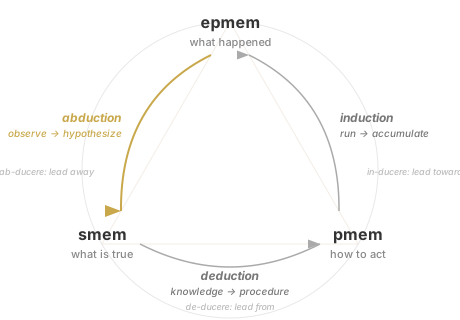
The monoid broke in Soar because the abductive morphism (Observation → Theory) was missing. cons closed it manually; the Natural Framework gave the interface. Whether the third edge can be automated remains open.
That’s a different post.
For Charles Sanders Peirce (1839–1914), who named the third mode and spent thirty years writing in solitude, rejected from polite society, unrecognized for it.