Three Modes
Chapter 1 · Peirce 1878, 1903
This book treats reasoning as reducible to three operations: deduction, induction, and abduction. Deduction has millennia of formalization; induction, centuries. Abduction has been recognized since 1867 and still lacks a generally accepted measure as precise as a validity proof or a confidence interval. This chapter defines all three and shows that complex reasoning decomposes into compositions of them.
The dog that didn't bark
"Is there any other point to which you would wish to draw my attention?"
"To the curious incident of the dog in the night-time."
"The dog did nothing in the night-time."
"That was the curious incident."
— Arthur Conan Doyle, The Adventure of Silver Blaze (1892)
Holmesian reasoning is usually called deduction. This case is something else. You can reconstruct a deductive argument after the fact: dogs bark at strangers; this dog did not bark; therefore the intruder was no stranger. But where did the first premise come from? Holmes knows a thousand things about dogs, stables, night, and strangers. The work is not in the syllogism. It is in selecting which fact to attend to: the silence of the dog rather than the lock, the weather, the groom's alibi, the color of the horse.
Absence is the signal; a quiet night is the background. Separating one from the other is the operation the tradition misnamed.
Peirce called it the neglected third mode of reasoning. Sharp diagnosticians do it fast: separate what matters from what doesn't. Every scientist, doctor, engineer, and detective performs it constantly. They have local names (diagnosis, root cause analysis, hypothesis generation) but no shared theory.
Three modes, three Latin roots
Charles Sanders Peirce identified the trichotomy in 1878 and refined it over the next twenty-five years. All three terms derive from Latin ducere ("to lead"):
Deduction (de-ducere, "to lead from"): given premises, derive consequences. If all men are mortal and Socrates is a man, then Socrates is mortal. The conclusion adds nothing not already in the premises. Two millennia of formalization back it, from Aristotle's syllogisms through Frege's predicate logic to modern theorem provers, type checkers, and SAT solvers.
Induction (in-ducere, "to lead toward"): given examples, generalize a pattern. Every swan I've seen is white; probably all swans are white. The conclusion extends beyond the observed cases but stays within the same conceptual frame. Bacon elevated it to systematic method in 1620, Fisher and Neyman formalized it in the twentieth century, and it underpins statistical inference and supervised machine learning.
Abduction (ab-ducere, "to lead away"): given a surprising observation, propose what would make it unsurprising. The lawn is wet but it didn't rain; perhaps the sprinkler ran overnight. The conclusion goes beyond both premises and data. It introduces a new idea. Peirce gave it its classic treatment in 1878 under the name hypothesis, later calling it abduction or retroduction. It still lacks a quantitative framework comparable to deductive validity or statistical inference.
Same beans, three syllogisms
Peirce illustrated the three modes by rotating a single example. The classic version uses beans:
| Mode | Premises | Conclusion | Status |
|---|---|---|---|
| Deduction | All beans from this bag are white. These beans are from this bag. | These beans are white. | Certain |
| Induction | These beans are from this bag. These beans are white. | All beans from this bag are white. | Probable |
| Abduction | All beans from this bag are white. These beans are white. | These beans are from this bag. | Plausible |
Each mode rearranges three propositions (Rule, Case, Result). Deduction: Rule + Case to Result. Induction: Case + Result to Rule. Abduction: Rule + Result to Case. The logical form is symmetric; the epistemic status is not.
Deduction preserves truth with certainty. Induction converges under assumptions: sufficient samples, stable distribution. Abduction proposes a candidate that might be entirely wrong.
# Three propositions. Three arrangements. Three epistemic statuses.
rule   = "All beans from this bag are white"
case   = "These beans are from this bag"
result = "These beans are white"

# Deduction: Rule + Case → Result. Certain.
print("Deduce:", result, "  (given rule and case)")

# Induction: Case + Result → Rule. Probable.
print("Induce:", rule,   "  (given case and result)")

# Abduction: Rule + Result → Case. Plausible.
print("Abduce:", case,   "  (given rule and result)")
The code makes the symmetry visible: same data, three arrangements, three epistemic statuses.
The symmetry is also a trap. Peirce fell into it himself. His 1883 Johns Hopkins paper treated hypothesis as a variety of induction, and his 1903 Lowell lecture on abduction admits it plainly: "my mind became so preoccupied with Induction that I forgot the peculiarities of Abduction and in that paper I confused it with a particular variety of Induction" (MS [R] 475). The same lecture states the repaired boundary, and the boundary is temporal:
"Induction must mean the operation that induces an assent, with or without quantitative modification, to a proposition already put forward ... while Abduction must cover all the operations by which theories and conceptions are engendered."
— Peirce, Eighth Lowell Lecture (1903), MS [R] 475; CP 5.590
Induction evaluates a proposition already on the table. Abduction is whatever put it there. The boundary defeated its own author for twenty years; expect it to blur, and repair it with the already-put-forward test.
Why three and only three
In his 1903 Harvard lectures, Peirce argued the trichotomy is exhaustive. His argument rests on three irreducible kinds of relation.
A monadic relation is a quality of a single thing. A dyadic relation connects two things (cause and effect, stimulus and response). A triadic relation connects three things in a way that cannot be reduced to pairs (a sign, the object it represents, and the interpretation it produces).
Deduction is monadic: it unpacks what the premises already contain. Induction is dyadic: it correlates cases with results. Abduction is triadic: it relates observation, rule, and case irreducibly. Monadic, dyadic, and triadic exhaust the irreducible relation types, so three modes exhaust the kinds of inference.
Peirce's argument assumes that no relation of arity four or higher is irreducible. Whether that holds depends on how you formalise "irreducible." This book bets that apparent fourth modes reduce to compositions of the three. The claim is empirical and still unproven.
One cycle, self-correcting
The three modes form a cycle. Each takes one kind of thing and produces another:
Abduction: Observation → Theory. Something surprising (a symptom, a bug, an anomaly) provokes a hypothesis. New ideas enter inquiry through abduction.
Deduction: Theory → Experiment. The hypothesis yields consequences. If this theory holds, we should observe X under conditions Y. Knowledge becomes procedure.
Induction: Experiment → Observation. Run the experiment, accumulate evidence, compare results to prediction. New observations feed back into the cycle.
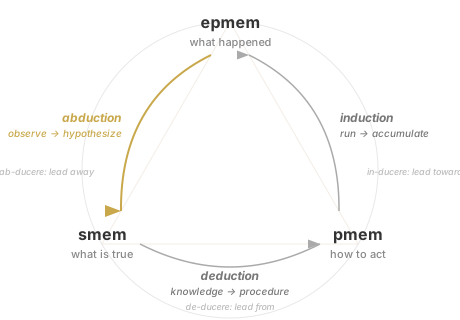
Self-correcting inquiry traverses all three edges. Partial traversals yield partial inquiries: a hypothesis without a test (abduction alone), a test without a hypothesis (induction alone), a prediction without data (deduction alone). Only the full cycle self-corrects.
Four domains, one triangle
The triangle appears in medicine, engineering, science, and daily life. Vocabulary changes; structure does not.
Medicine. A patient presents with fever, joint pain, and a butterfly-shaped facial rash. The doctor proposes lupus (abduction). If lupus, antinuclear antibodies should be elevated (deduction). The lab runs the ANA test and reports a high titer. The doctor updates confidence given the test's sensitivity and the patient's presentation (induction). A positive ANA supports but does not confirm lupus; the test is sensitive but not specific. The new observation narrows the differential or forces a new hypothesis.
Debugging. A server returns 500 errors on every third request. The engineer suspects connection pool exhaustion (abduction). If the pool is exhausted, active connections should climb to the limit before failures begin (deduction). She checks the connection count at failure time (induction). The pool is nowhere near its limit: wrong hypothesis. She abduces again: maybe a thread-safety issue in the request handler.
Science. Darwin observed that finch beak shapes vary across the Galapagos islands. (The history is messier than this schematic suggests, but the logical structure holds.) He proposed that beak shape tracks food source. Different environments select for different beaks (abduction). If natural selection drives beak shape, islands with hard seeds should have finches with stronger beaks (deduction). Decades of field measurement confirmed the correlation (induction).
Everyday life. You flip a light switch and nothing happens. The bulb burned out (abduction). If so, replacing it should restore the light (deduction). You swap the bulb; the light turns on (induction).
Three primitives compose everything
Complex reasoning decomposes into compositions of the three:
Analogy = abduction (notice a surprising similarity across two domains) + induction (generalise the structural correspondence). Peirce analysed it this way. Brewer's account of legal reasoning supports the same decomposition.
Diagnosis = abduction (propose what is wrong) + deduction (derive the observable consequences of that fault).
Scientific method = abduction (hypothesise) + deduction (predict) + induction (test). The full triangle.
Debugging = abduction (propose a cause) + deduction (if this cause, then that symptom) + abduction again (it wasn't that; next cause). Debugging is abduction-heavy because the hypothesis space is large and each test eliminates only one candidate.
Legal precedent = abduction (match the current case to a prior case) + induction (generalise a principle from the precedent) + deduction (apply the generalised rule to the current facts).
Holmes, House, Semmelweis, Darwin. Same compositions, different costumes.
Twenty-three centuries to name three modes
The trichotomy accumulated slowly.
| Date | Who | Contribution |
|---|---|---|
| ~350 BC | Aristotle | Formalised deduction (syllogistic logic). Discussed induction (epagoge) but did not elevate it to a method. One mode formalised. Peirce later read the inference of Prior Analytics II.25 as abduction, abducing from papyrus sheet sizes that a corrupted word had hidden it (MS [R] 475). |
| 1620 | Francis Bacon | Novum Organum. Foregrounded induction as systematic method. Rejected Aristotle's deductive monopoly. Two modes recognised. |
| 1867 | Charles Sanders Peirce | "On the Natural Classification of Arguments." The trichotomy's first appearance, as three classes of argument. Peirce's 1903 retrospective points here (MS [R] 475). Three modes recognised. |
| 1878 | Peirce | "Deduction, Induction, and Hypothesis." Gave the third mode its classic treatment: the bean syllogisms. |
| 1903 | Peirce | Harvard lectures. Argued the trichotomy is exhaustive on mathematical grounds (monadic, dyadic, triadic relations). |
| 1934 | Karl Popper | Logik der Forschung. Rejected induction. All science is deduction from conjectures. Where conjectures come from, he did not say. (The answer is abduction. Popper did not use the word.) |
Rediscovered six times over
Abduction keeps getting rediscovered. At least eight entries across six fields describe the same pattern: given an observation, separate what demands attention from what can be held constant. Gestalt psychologists call it figure-ground segregation; Piaget, equilibration; Calcagno, bi-abduction. Each field coined its own term. Chapter 3 lays out the full table and extracts the common structure.
Inference to the best explanation is a different operation
Philosophers often treat abduction as a synonym for inference to the best explanation. Harman (1965) introduced that phrase and presented it as the modern name for Peirce's abduction, and the equation stuck. The two operations answer different questions, and everything this book builds runs on the difference.
Inference to the best explanation is a rule of acceptance. Given rival explanations of the evidence, it licenses concluding that the best one is true. Its classic difficulty follows immediately: van Fraassen objected that the best available explanation may be the best of a bad lot, so ranking first among rivals is no ground for belief. Peirce's abduction is a rule of pursuit. Its conclusion is a question mark. "Abduction commits us to nothing," Peirce wrote; "it merely causes a hypothesis to be set down upon our docket of cases to be tried" (MS [R] 475). Nothing is accepted at the abductive step. Acceptance waits for induction, after the tests run. Notice that the bad-lot objection, fatal to a rule of acceptance, glances off a rule of pursuit: docketing the best of a bad lot costs one test, and the test is what exposes the lot as bad.
The difference is what gives this book a subject. If abduction ended by accepting the best explanation, Chapter 9's economy of research would have nothing left to do; the ranking would already be a verdict. Because abduction only files candidates, deciding which to test first, at what cost, and when to quit is the entire remaining problem, and the following seventeen chapters are that problem. Where acceptance finally happens, it will be earned by survived tests and differential traces, never by explanatory beauty.
Missing ruler
Three modes, defined. A cycle connecting them. Cross-field recurrence. Decomposition rules that reduce complex reasoning to compositions of the three.
But we cannot measure abduction. We can say it is "more fertile" than deduction and "less certain" than induction, but those are ordinal claims, never quantitative. How fertile? How uncertain? Can we compare two abductive inferences and say which is better before testing either?
Peirce addressed this late in life with two terms: security (how certain is the conclusion?) and uberty (how much new knowledge does it produce?). He claimed security and uberty are inversely related. The tradeoff is structural. If he's right, it constrains the design space of any system that reasons. If he's wrong, abduction is just guessing with extra syllables.
That tradeoff is the subject of Chapter 2.
Exercises
💻 marks exercises meant for a keyboard. ★ marks open-ended problems with no single right answer.
1.1 Peirce's repaired boundary is temporal: induction evaluates a proposition already put forward, abduction is whatever put it there. Apply the already-put-forward test to a jury weighing an alibi and to the detective who first proposed the suspect. Which mode is each performing, and why?
1.2 Classify the inference in each scenario as deduction, induction, or abduction, and write it out as a Rule, Case, Result syllogism: (a) your cat sprints to the kitchen at the sound of the can opener; (b) a sommelier tastes an unfamiliar wine and says "volcanic soil, probably Etna"; (c) a compiler rejects your program because the function requires an integer and you passed a string; (d) a poll of 1,200 voters projects the winner of an election. One of the four compresses two modes into a single act; identify which, and separate them.
1.3 Peirce rotated one bean example through all three modes. Do the same with a triple from a domain you know well: choose a Rule, a Case, and a Result, write the three arrangements, and mark each conclusion Certain, Probable, or Plausible. Then say which arrangement you perform most often in a normal week.
1.4 💻 The bean code prints three fixed arrangements. Write a program that takes the three propositions as strings, enumerates every way of choosing two as premises and one as conclusion, and prints the distinct inference patterns (hint: there are exactly as many as there are choices of conclusion). Then explain why this counting argument is weaker than Peirce's monadic, dyadic, triadic argument for why the modes number three.
1.5 ★ Reconstruct a real inquiry you ran recently (a debugging session, a medical visit, a burnt dinner) as a walk around the triangle: list each step, label its edge as abduction, deduction, or induction, and find at least one place where you skipped an edge. What did the skip cost, or why was it safe?
Sources
| Peirce 1878 | "Deduction, Induction, and Hypothesis." Popular Science Monthly. Names abduction as the third mode of inference. |
| Peirce 1903 (Harvard) | Harvard Lectures on Pragmatism. MSS [R] 301–316, Houghton Library, Harvard. Published in The Essential Peirce vol. 2, pp. 133–241 (Indiana UP, 1998); also Archive.org. Argues the trichotomy is exhaustive on categorical grounds. |
| Peirce 1903 (Lowell) | Eighth Lowell Lecture, "Abduction." MS [R] 475, Houghton Library, Harvard; reprinted in part as CP 5.590–604. Photographed June 2026; page images (CC0) and draft transcription here, mirrored on the Internet Archive. The mature definitions, the confession of the 1883 confusion, and the Aristotle II.25 conjecture. |
| Bacon 1620 | Novum Organum. Elevated induction to systematic method. |
| Popper 1934 | Logik der Forschung. All science is deduction from conjectures; discovery has no logic. |
| Doyle 1892 | "The Adventure of Silver Blaze." The dog that didn't bark. Holmes performs abduction; the tradition calls it deduction. |
| Brewer 1996 | "Exemplary Reasoning." Analyzes legal analogy as abduction + induction. |