Why There Are No Ads in Your Chatbot
Part of the Vector Space series.
I swept 349 AI companion apps on the App Store this week. The number running ads: zero. Every one is subscription-only, so every free conversation costs its founder money and earns nothing. Ask First laid out why that can’t last. Subscriptions have a ceiling, and advertising is the only model that ever scaled with free usage. So I went looking for why it lasts anyway; this is what I found.
The first suspect was the matching technology, so I probed the leading in-chat ad network’s flagship publisher. “5 day trip to Lisbon on a budget” drew a Portugal tour operator, destination-level, live: conversational matching at a precision keywords never reach (background). Then “why is the sky blue” drew monday.com. Then the Lisbon question, asked again, drew monday.com too. Seven queries, seven ads: one B2B reach budget covered four of them, and a mental-health disclosure was served like everything else. The network is small enough that one campaign steamrolls relevance across every intent (its own homepage: 100M queries a year). The technology critique of chat ads is dead. The market-design critique is the whole story.
But even a well-matched ad has to out-earn the answer it rides on. The unit economics reduce to one inequality: revenue per response against inference per response. Ask First had the cost side (OpenAI’s $14B inference forecast); the field supplies the revenue side. The operator who ran every query through a 348-model ensemble shut down. The operator whose answers carry live search fled to enterprise. One operator who has run in-chat ads for years told me his free users break even. Break even, the best confirmed outcome in the market. And Chai’s founder stated the ceiling geographically: ads sustain free users in the US and Europe and fail to in low-revenue countries, so those countries got a mandatory subscription priced to cover electricity. Advertising in chat tops out at “the free tier stops bleeding.”
So nobody stays. The market has three tiers, and each one leaves by a different door. The top, surface owners holding nearly all conversational intent, exits to commerce. Perplexity killed ads at $20K total revenue while growing, and kept shopping; ChatGPT tested ads while building checkout. When you own the transaction, renting the moment to someone else’s message is strictly worse. The middle, the funded operators, exits to enterprise or gets steamrolled. Capability portfolios bill by the seat, and the one network serving the middle is thin enough that a single reach budget defeats its own matcher. The bottom, the 349, never enters: below the ceiling and unscattered.
Two diagonal exits cut across all tiers. First-party funnels route intent to their own shelf at every size: a fintech chat measured third-party referrals against its own cash advances and killed the referrals, and OpenAI is the same decision at scale. Trust positions leave at any revenue. Even the one publisher who answered my cold email, a sobriety app founder sitting on exactly the inventory the theory prizes most, had his own exit. He already sells his users’ therapy interest as signup leads, and I could come back with a literal check.
It is a five-forces verdict. Substitutes beat the ad model for every participant, the frontier labs hold supplier power over everyone’s differentiation, and the surface owners are running commoditize-your-complement on the answer itself: free answers under an owned checkout. Every thesis in this space assumes an independent seller occupies the empty slot: conditional, out-of-band, beholden to no surface. It is empty because each tier’s economics forbid it: the top won’t spend trust, the middle can’t afford silence, the bottom can’t afford anything.
The exception should be the verticals where intent is worth the most, but that is where my own series needs its sharpest correction. Monetizing the Untouchable framed health-conversation inventory as fenced by privacy enforcement, which architecture can answer. The field says the binding fence is referral law. EKRA prices the money flow, not the data flow: paying per introduction to addiction treatment is a federal crime under any privacy architecture. State patient-brokering law extends the fence across health, and no enclave helps because the statute never asks where the data lived. The verticals with the most valuable utterances are exactly the ones where the per-intent transaction is illegal. Untouchable turned out to be the right word for the wrong reason.
But the demand the fence leaves standing fails a different test: intent matching only serves advertisers a user’s sentence can select. “I need a freelancer” selects Upwork; no sentence selects a generic AI assistant, which is why AI apps advertising inside other AI apps is a circular economy waiting for its 2000. The Keyword Tax showed keywords overcharging specialists; the mirror-image finding is that intent matching structurally cannot serve the undifferentiated at any price. The demand that steamrolled my probes fails this test: no user sentence selects a work OS for everyone, and the base-rate evidence is what real intents look like in the wild. Ries and Trout argued forty years ago that a brand must own a sentence in the customer’s mind; a recommendation engine is positioning theory with a compiler, and it rejects unpositioned advertisers at build time.
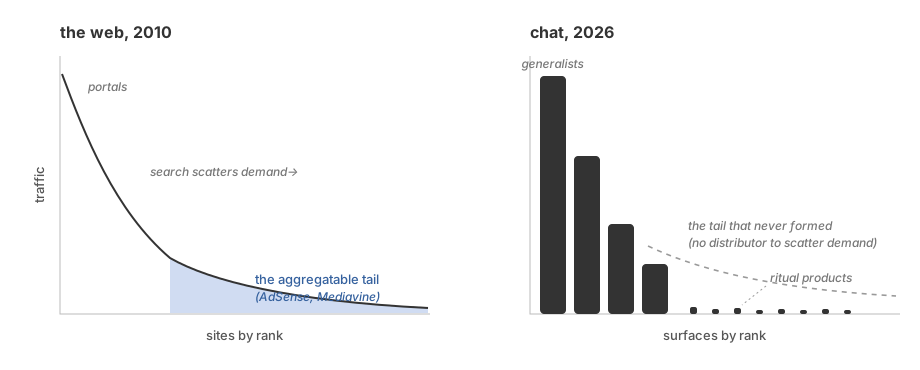
But the ceiling, the fences, and the thin demand are all proximate. The deepest reason corrects Who Builds It?. I mapped five forces converging on the embedding auction and missed the force that doesn’t come. Chat collapses the distribution structure that made web advertising abundant. Ben Thompson’s Aggregation Theory says internet value accrues to whoever aggregates demand; search was the rare aggregator that redistributed attention outward, and that redistribution made the blog tail monetizable. Chat aggregates demand and supplies the answer itself (no distributor, nothing scattered), so no tail of small surfaces forms downstream, and the click already stopped mattering on the surface that used to do the scattering. What survives the generalists is small. Products that contain conversations survive, held up by things a generalist won’t build: a ritual, a community, a catalog, a name. Today that tail sits below aggregation economics.
So the market waits on its bootstrap problem (Stone Soup). Three things would solve it, written down so I can be held to them: a surface owner exposing a buying or measurement API that creates a denomination an independent party can clear; a mature operator showing slope, ad revenue growing rather than subsisting; or one ads-native app crossing from break-even to profit in public. Revenue models summon supply, and every long tail started with one existence proof. The mechanism waits either way: the auction, the adserver, and the placement rules that survive everything above. The wood is wet. Sparks are cheap. I’m watching for dry wood.